
Product Overview
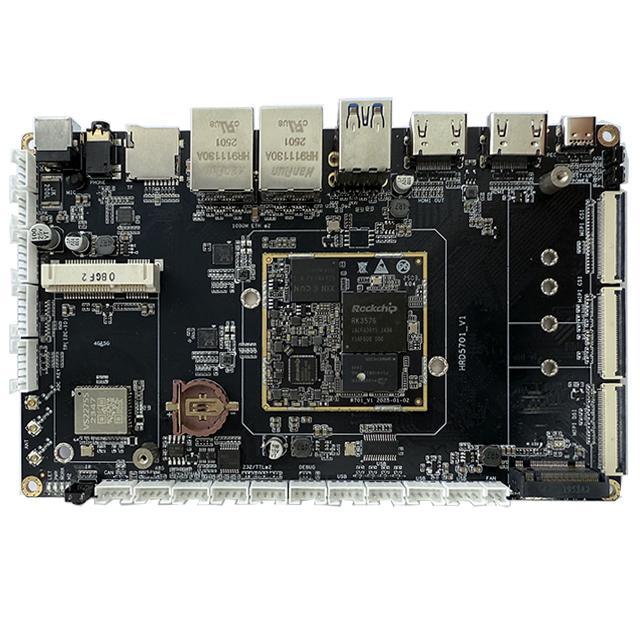
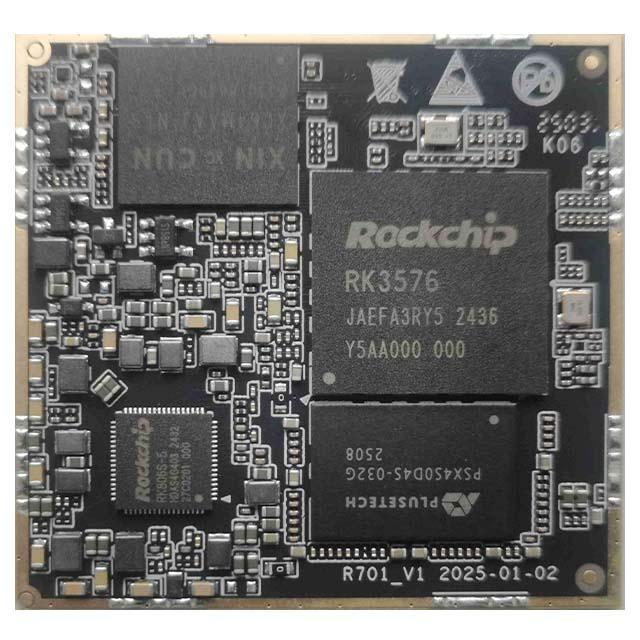
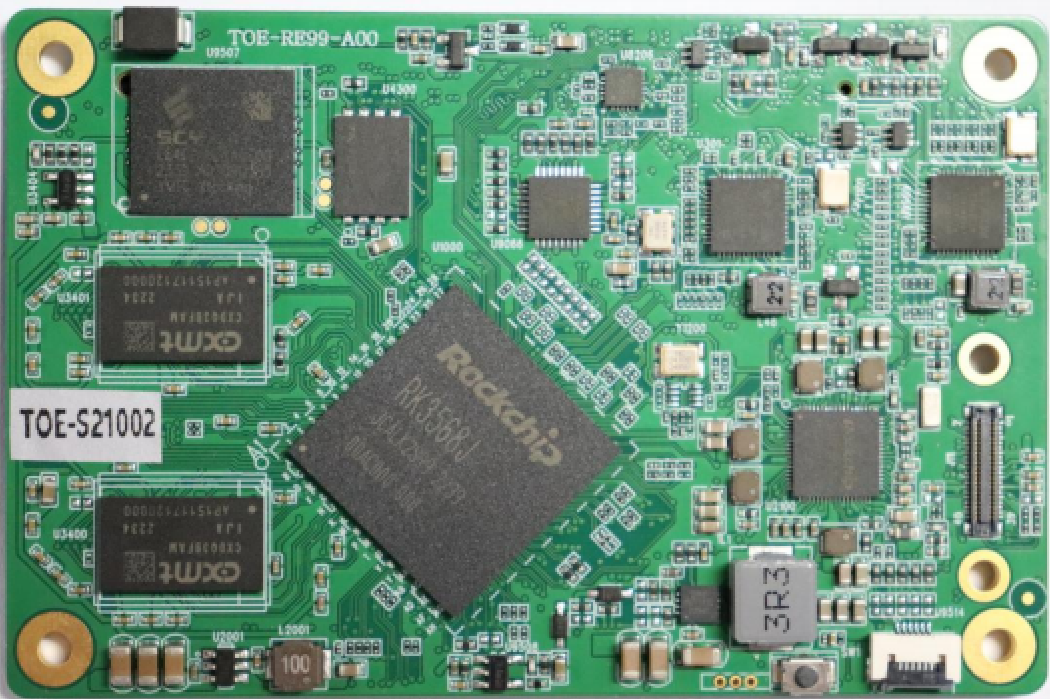
The mainboard is powered by the Rockchip RK3576 octa-core processor, featuring a 4-core Cortex-A72 + 4-core Cortex-A53 architecture. It supports Android/Linux + Qt/Ubuntu operating systems, with the A72 cores clocked at up to 2.3GHz and the A53 cores at up to 2.2GHz. It integrates a Mali-G52 MC3 GPU and a built-in 6 TOPS NPU for AI acceleration. Memory is supported up to 16GB.
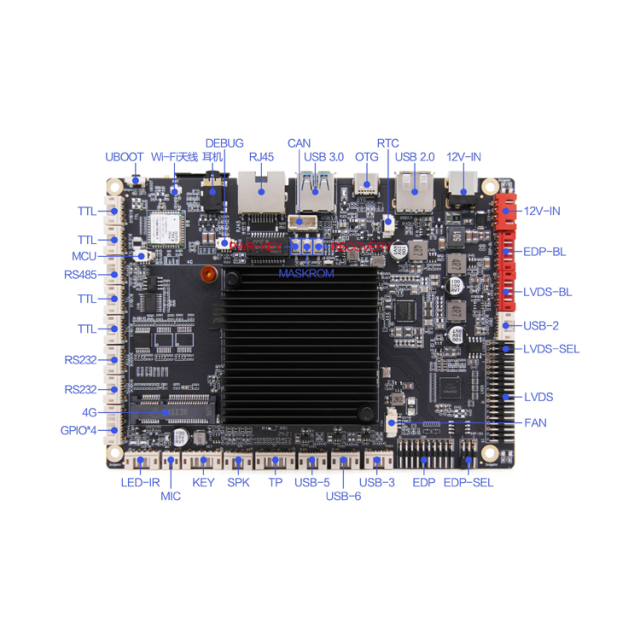
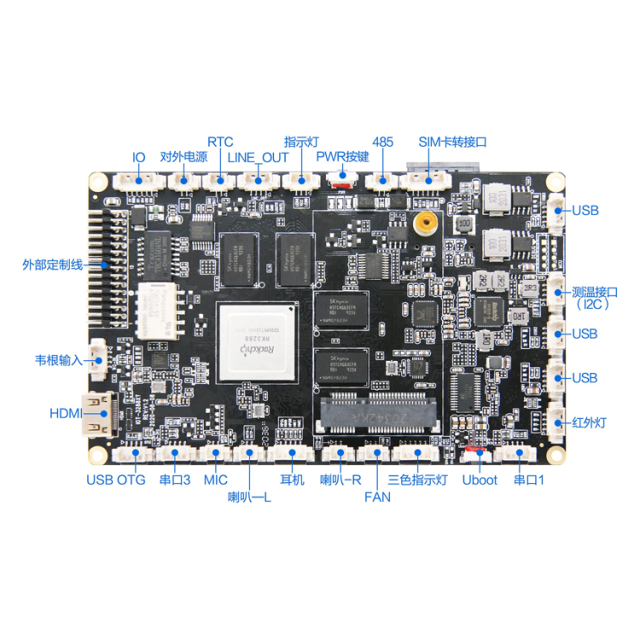
The board supports mainstream display interfaces and multi-display output, while offering a rich selection of interfaces with all major functional pins exposed. It also supports various peripheral expansion options, making it an ideal choice for human-machine interaction (HMI), industrial control, and smart embedded applications.
Core Hardware Specifications
- CPU: 4× Cortex-A72 @ 2.2GHz + 4× Cortex-A53 @ 1.8GHz, featuring an octa-core 64-bit big.LITTLE architecture with an integrated Cortex-M0 coprocessor.
- GPU: Mali-G52 MC3, supporting Vulkan 1.1 and OpenGL ES 3.2 for 3D graphics rendering.
- NPU: 6 TOPS INT8 AI computing power, based on the RKNN architecture. Supports INT4-FP16 mixed-precision computing and local deployment of AI models, including large language models, object detection, and image recognition. Compatible with frameworks such as PyTorch, TensorFlow, Caffe, and TFLite.
- Multimedia Codec
- Video Decoding: Up to 8K@30fps H.265/H.264/AV1/VP9 hardware decoding.
- Video Encoding: Up to 4K@60fps H.264/H.265 hardware encoding.
- ISP: Supports up to 16MP image processing, multi-channel MIPI-CSI camera inputs, HDR, and 3DNR noise reduction.
- Memory & Storage: Supports LPDDR4/LPDDR4X/LPDDR5, with up to 16GB memory. Storage options include eMMC 5.1, TF card, and PCIe NVMe SSD expansion.

Basic Function List
Main Hardware Specifications
| Parameter | Specification |
|---|---|
| Board Dimensions | 165 mm (L) × 102 mm (W) × 18.5 mm (H) |
| CPU | Rockchip RK3576 Octa-Core (Cortex-A72 + Cortex-A53) |
| NPU | 6 TOPS Neural Network Processing Unit |
| GPU | Mali-G52 MC3 |
| Memory | LPDDR4X, configurable: 2GB / 4GB / 8GB / 16GB |
| Storage | eMMC 5.1, configurable: 32GB / 64GB / 128GB |
| Storage | UFS 2.0, 64GB standard; 128GB–512GB optional |
| Power Management | RK806S-5 |
| Operating Voltage | 12V, ≥2A |
| Supported OS | Android 14 |
| Operating Temperature | -10°C to +75°C |
Main Interfaces
| Interface | Specification |
|---|---|
| USB 2.0 | 4 × USB ports (internal) |
| USB 3.0 | 1 × USB 3.0 OTG + 2 × USB 3.0 HOST |
| USB Type-C | USB 3.0 OTG + DP Display |
| Serial Ports | 4 × UART; 2 × RS232 multiplexed, including 1 × Debug UART |
| I²C | 1 × I²C interface |
| CAN | 1 × CAN bus interface |
| RS485 | 1 × RS485 interface |
| GPIO | 4 × available GPIOs (multiplexed) |
| SPI | 1 × SPI interface |
| ADC | 4 × ADC inputs (1.8V) |
| HDMI Output | 1 × HDMI output, up to 4K; multiplexed with eDP |
| MIPI DSI Display | Supports 1 × MIPI DSI display |
| DP Display | 1 × DP display interface, up to 1080P |
| MIPI CSI Input | Supports 4 × MIPI CSI camera inputs; up to 16MP ISP |
| Audio Output | 1 × headphone left/right channel output; 2 × speaker outputs, 5W / 8Ω |
| Audio Input | 1 × microphone input |
| Ethernet | 2 × Gigabit Ethernet via RGMII |
| Wi-Fi | Wi-Fi 6, based on RTL8822CS |
| Bluetooth | Bluetooth 5.0 + BLE, based on RTL8822CS |
| 4G | 1 × M.2 4G module interface via USB |
| M.2 Storage | 1 × PCIe M-Key interface for SSD |
| RTC | External HYM8563 RTC chip, power consumption <0.2μA |
| TF Card | Supports TF card expansion |
| RTC Backup | External coin-cell battery for time retention during power loss, using independent HYM8563 RTC |
| System Upgrade | Supports local USB system upgrade |
Supported Operating Systems
- Android 14 — Native Android support, suitable for Android terminals and commercial displays.
- Linux — Supports Debian 12, Ubuntu 24.04, Buildroot, and the RT-Thread real-time operating system.
- Provides a complete BSP, kernel source code, and RKNN toolchain for convenient secondary development and customization.
Typical Applications
- Edge AI Computing Boxes: Object detection, facial recognition, and local AI model deployment. The 6 TOPS NPU can handle lightweight LLM inference.
- Industrial Control & HMI: Supports CAN-FD and RS485, enabling integrated display and control and helping replace traditional industrial PC + display solutions.
- Smart Commercial Displays & Digital Signage: Supports multi-display output and 8K video decoding.
- Smart Conference Terminals & Multi-Channel Video Recording Devices.
- Automotive Electronics, E-Ink Readers, and ARM Mini PCs.
Advantages & Limitations
✅ Advantages
- Balanced performance and cost: The 8nm process helps deliver high performance with controlled power consumption.
- Powerful edge AI capabilities: The 6 TOPS NPU is sufficient for most edge AI applications and supports local AI model inference.
- Rich interfaces: Combines multimedia processing capabilities with industrial interfaces for versatile embedded applications.
- Comprehensive SDK support: Supported by multiple domestic solution providers, with a stable local supply chain.
⚠️ Limitations
- 6 TOPS NPU performance: Large-scale AI models may require an external M.2 AI accelerator for higher-performance inference.
- Core board pinout compatibility: Pin definitions may vary between manufacturers, so hardware compatibility should be carefully checked during product selection.