
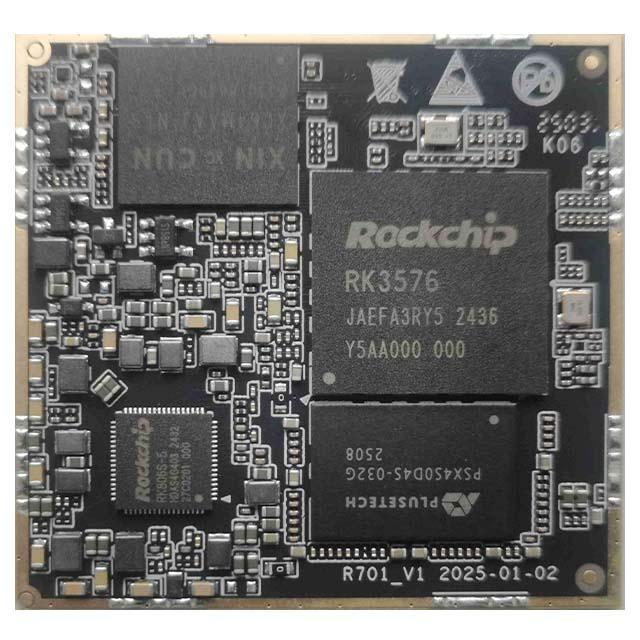
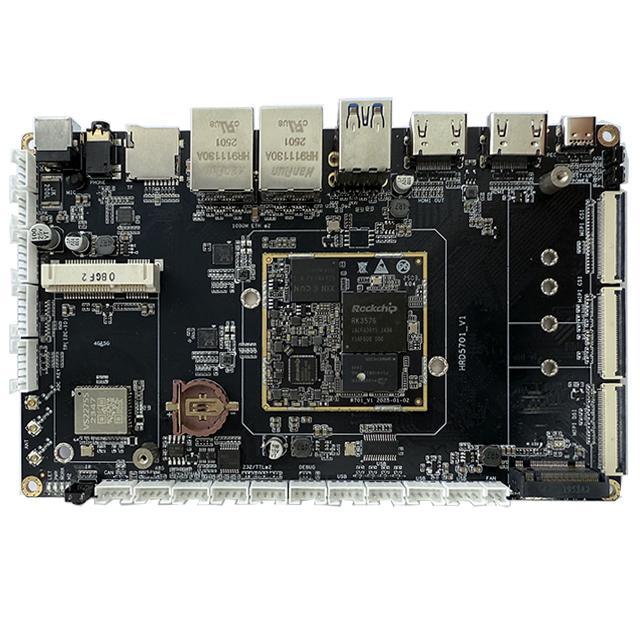
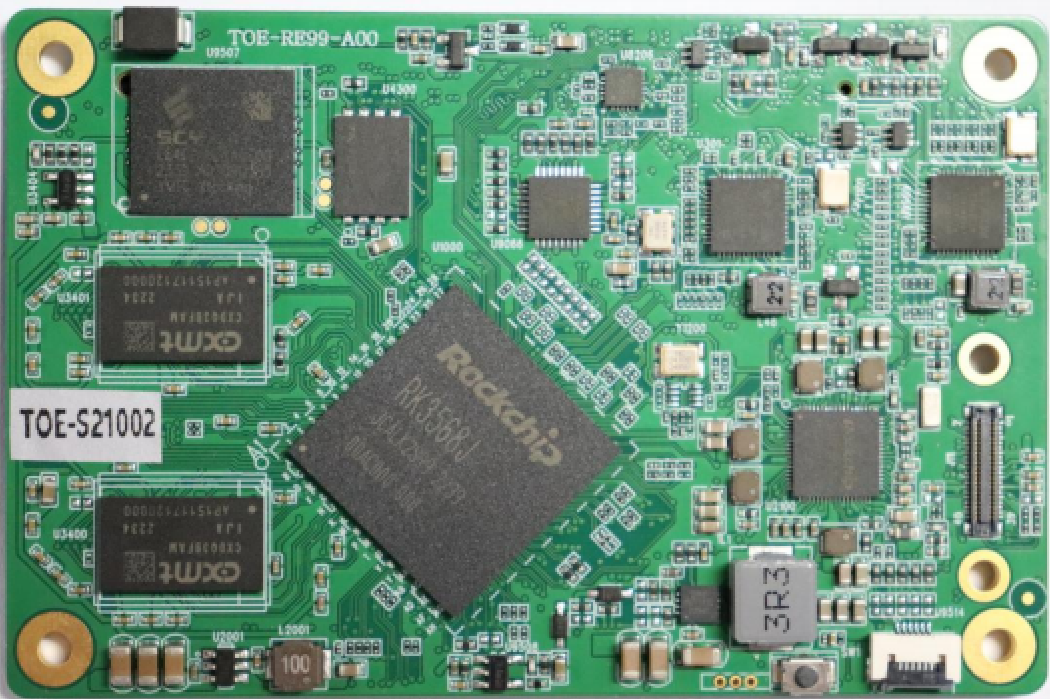
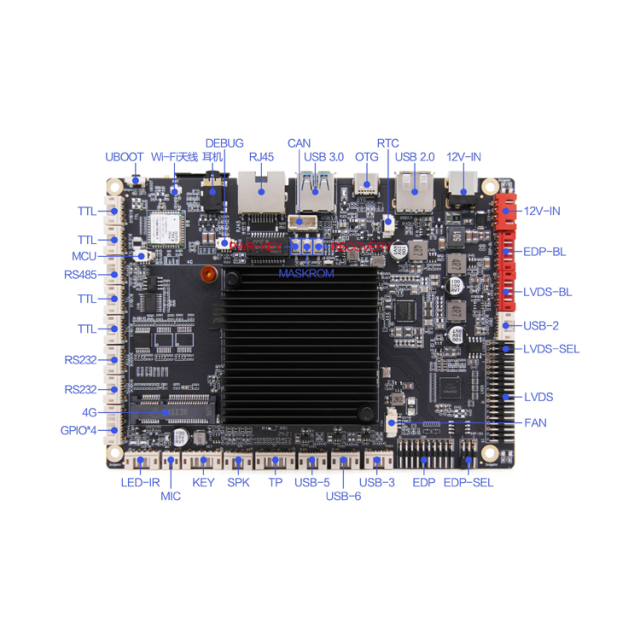
Powered by the ROCKCHIP RK3576 octa-core processor, the module features four Cortex-A72 cores + four Cortex-A53 cores, with A72 cores running at up to 2.3GHz and A53 cores up to 2.2GHz. It integrates a Mali-G52 MC3 GPU and a built-in 6 TOPS AI NPU, supporting up to 16GB memory.
The core board supports mainstream display interfaces, multi-display independent output, and rich peripheral expansion options. All functional pins are exposed for flexible customization, making it an ideal solution for human-machine interaction (HMI), industrial control, edge AI, and smart IoT applications.
RK3576 Main Chip Specifications
- CPU:
4× Cortex-A72 @ 2.2GHz + 4× Cortex-A53 @ 1.8GHz
Built-in Cortex-M0 real-time MCU, supporting AMP heterogeneous architecture for real-time RTOS task processing. - NPU:
6 TOPS INT8 AI computing power
Supports RKNN framework, lightweight AI model inference, and AI applications such as YOLO. Supports INT4/FP16/BF16 precision formats and enables model conversion from PyTorch / TensorFlow / ONNX frameworks. - GPU:
Mali-G52 MC3 GPU
Supports OpenGL ES 3.2 and Vulkan 1.2, enabling three-screen independent display output. - Multimedia VPU:
- Video Decoding:
Supports 8K@30fps / 4K@120fps H.265, AV1, VP9, AVS2 decoding;
Supports 4K@60fps H.264 decoding. - Video Encoding:
Supports 4K@60fps H.264/H.265 encoding.
- Video Decoding:
- ISP (Image Signal Processor):
Supports up to 16MP image sensors, with HDR, 3A control, noise reduction, fisheye correction, and multiple MIPI-CSI camera inputs.

RK3576 LGA SOM Module Hardware Specifications
1. Package Type: LGA Soldered Package
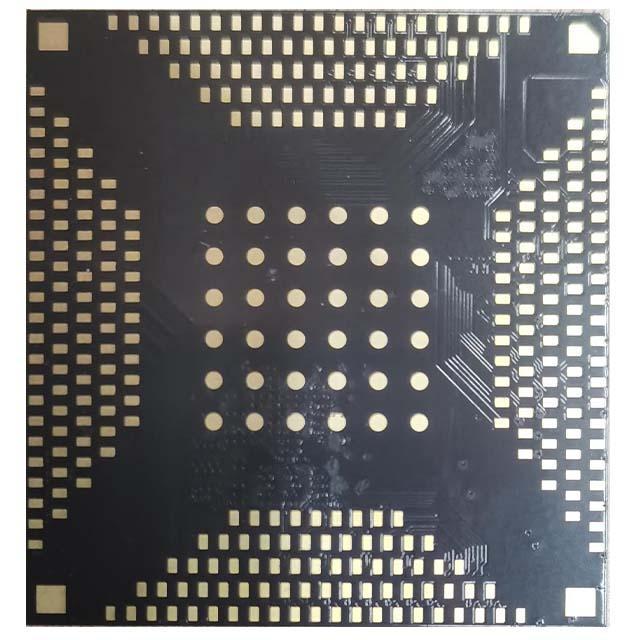
The LGA (Land Grid Array) package adopts a flat pad array design without pins. The module is directly mounted onto the baseboard through SMT reflow soldering. Some versions also adopt a hybrid LGA + LCC castellated hole design.
Advantages:
- Excellent vibration and shock resistance
- Better EMI (electromagnetic interference) performance
- Suitable for industrial-grade mass production
Limitations:
- Non-pluggable after soldering
- Maintenance requires professional rework equipment
- The carrier PCB must strictly match the core board LGA footprint and pad layout
2. Memory & Storage Configuration Options
Memory:
- LPDDR4X / LPDDR5
- 2GB / 4GB / 8GB options available (mainstream configurations)
Storage:
- eMMC 5.1 / UFS 2.0
- 16GB / 32GB / 64GB / 128GB / 256GB optional
3. High-Speed Interfaces (All Routed Through LGA Pads)
The RK3576 LGA core board exposes all functional interfaces through the LGA pad array, providing flexible expansion capabilities.
Display Interfaces:
- HDMI 2.0
- DisplayPort (DP)
- eDP
- MIPI-DSI
- RGB interface
- EBC electronic paper display interface
- Supports three-screen independent display output
Network Interfaces:
- Dual Gigabit Ethernet GMAC
High-Speed Bus Interfaces:
- PCIe 2.1 ×2
- SATA 3.1
- USB 3.2
- DSMC high-speed parallel interface
Industrial & Peripheral Interfaces:
- CAN-FD
- Multiple UART interfaces
- I2C
- SPI
- ADC
- PWM
- Multiple MIPI-CSI camera interfaces
4. Dimensions & Operating Temperature Range
Temperature Range:
- Commercial version: 0°C to +80°C
- Industrial version RK3576J: -40°C to +85°C
Dimensions:
Common sizes include:
- 43 × 45mm
- 45 × 30mm
(Actual dimensions may vary depending on different manufacturers.)
5. Supported Operating Systems
- Android 14 / Android 16
- Debian 12
- Buildroot
Supports:
- RT-Thread
- FreeRTOS running on the integrated Cortex-M0 MCU
- AMP heterogeneous architecture (Linux + RTOS coexistence)

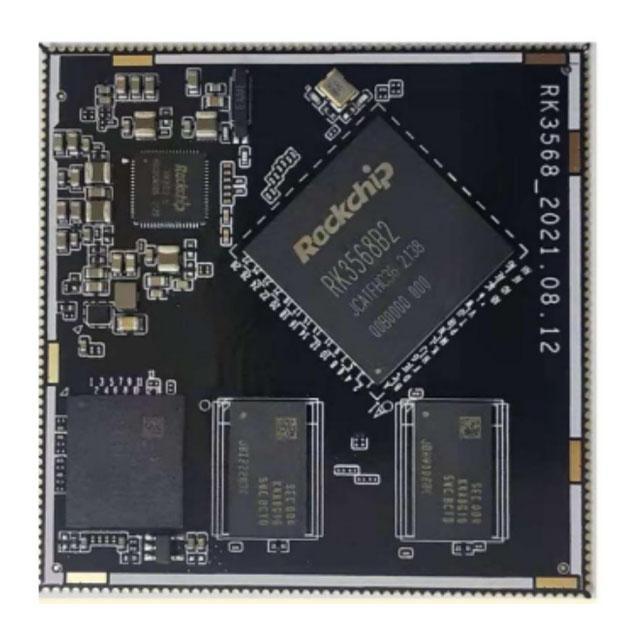
LGA Soldered Core Board vs. Castellated Hole Core Board
| Item | LGA Soldered Core Board | Traditional Castellated Hole Core Board |
|---|---|---|
| Assembly Method | SMT reflow soldering, ideal for mass production | Manual soldering / wave soldering, convenient for small-batch prototypes |
| Mechanical Reliability | Stronger vibration and shock resistance, preferred for industrial equipment | Higher risk of cracking or failure under severe vibration |
| EMC Performance | Better electromagnetic compatibility, supports shielding design | Average |
| Repair & Replacement | Requires desoldering equipment, not directly replaceable | Easier to remove and replace |
| Carrier PCB Requirements | Requires accurate LGA footprint matching and stencil design | Simpler PCB routing and easier manufacturing |
Typical Applications
1. Industrial AI Edge Computing
- Industrial gateways
- Machine vision systems
- PLC controllers
- Inspection equipment
- Local AI recognition and camera analytics
2. Commercial Display & Self-Service Terminals
- Digital signage
- Advertising displays
- Self-service kiosks
- Multi-screen interactive terminals
3. Smart Devices
- Robots
- Access control systems
- Passenger flow analysis systems
- License plate recognition terminals
4. Medical Equipment
- 4K endoscopy systems
- Medical display terminals
(Industrial temperature-grade versions recommended)
5. Automotive & Special-Purpose Terminals
- Multi-camera data acquisition
- 360° panoramic vision systems
- Vehicle-mounted intelligent terminals
(Industrial RK3576J version recommended)
6. Local Large Language Model Deployment
- Supports lightweight local AI model inference
- Compatible with models such as Qwen and Gemma after optimization and quantization
Selection & Development Considerations
- Differentiate between commercial RK3576 and industrial RK3576J versions
The operating temperature range is different. Industrial applications should select the RK3576J version. - Use the official LGA footprint library for PCB design
The carrier board must strictly follow the manufacturer’s recommended footprint. Stencil design is critical to avoid soldering defects such as insufficient solder or open joints. - LGA modules are not hot-swappable
Once soldered, replacement requires professional hot-air rework equipment. - AI NPU deployment requires RKNN toolchain support
AI models need quantization and optimization before deployment. - Evaluate SDK maturity before selection
Confirm the availability of:- BSP support
- Device drivers
- Hardware reference designs
- Development documentation
- Technical support resources