
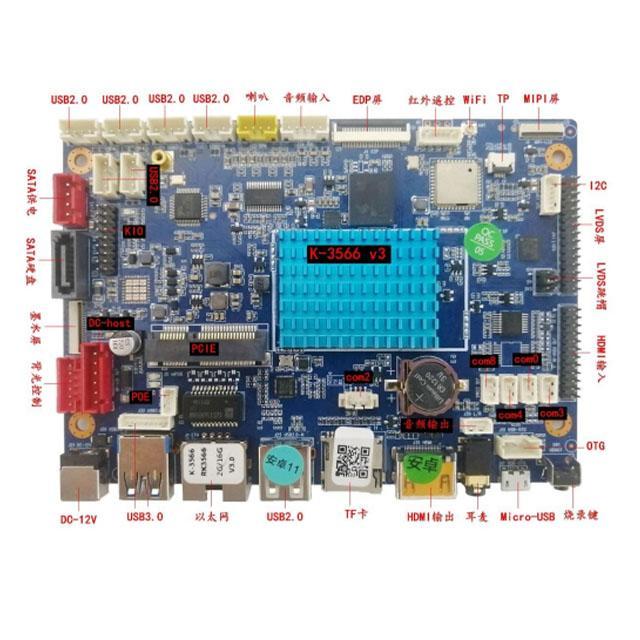
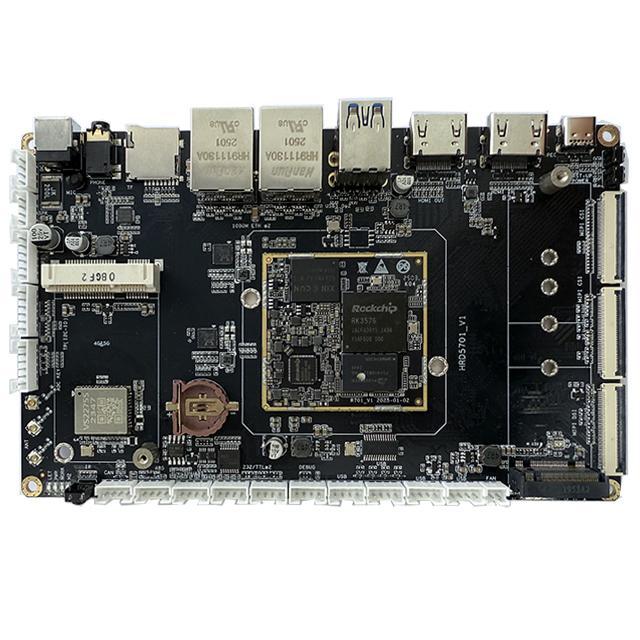
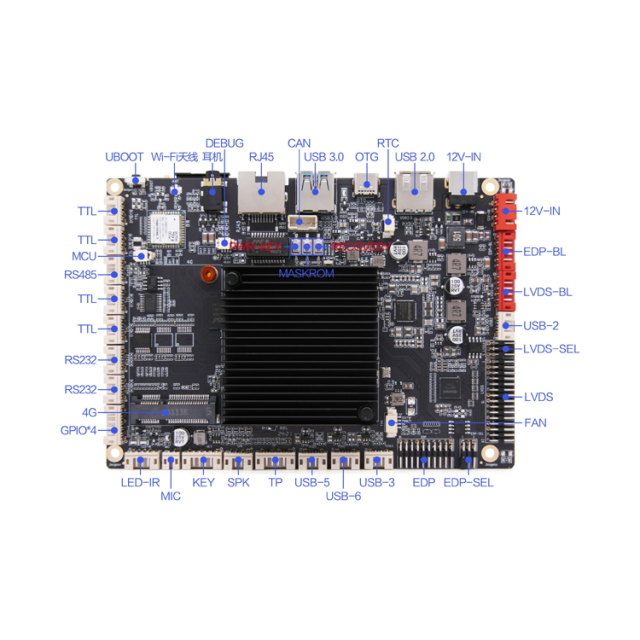
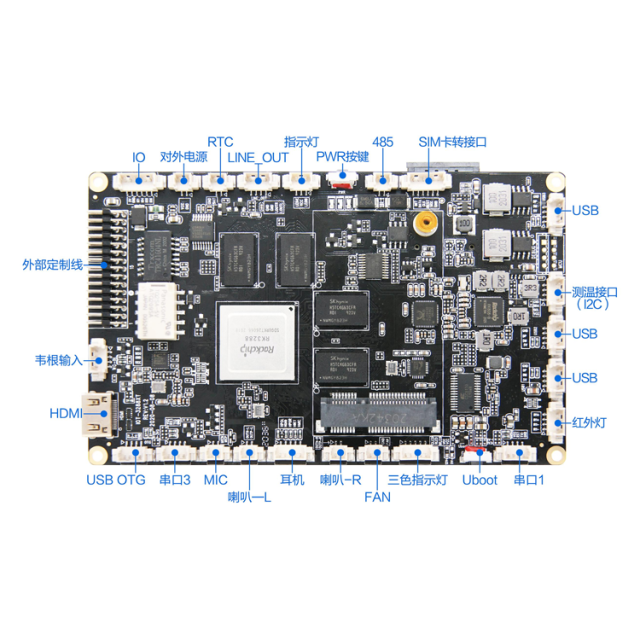
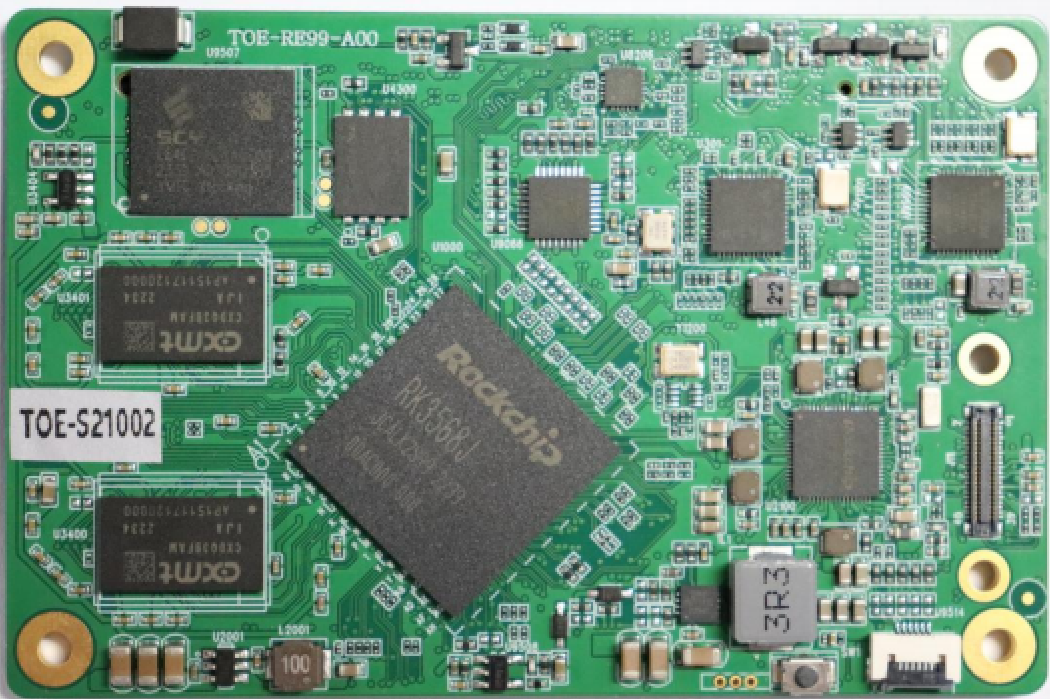
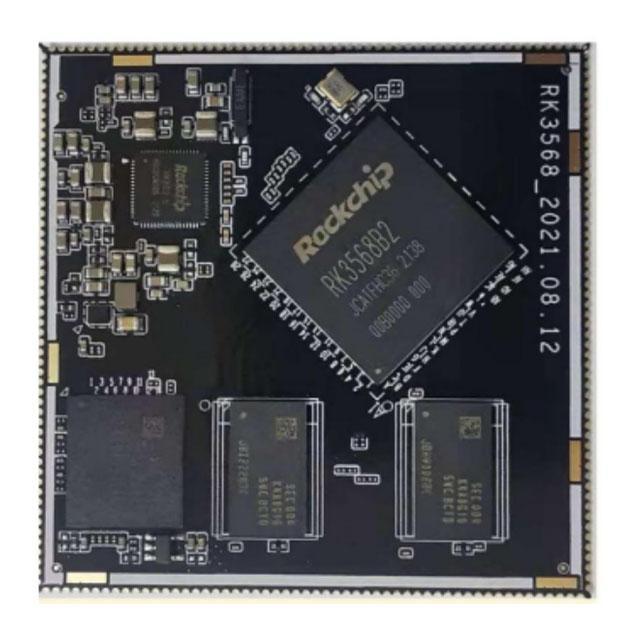
COM Express is an industrial modular standard (not a native Rockchip standard). It is divided into Compact (95 × 95 mm) and Basic (125 × 95 mm) form factors, with Type 6 being the mainstream pin definition. The SoC, DDR, eMMC, and PMU are integrated into the core module, which connects to a carrier board through standard connectors, facilitating product iteration, hardware reuse, and rapid processor replacement.
The RK3568 COM-E is an industrial core module that complies with the COM-E standard and uses the RK3568 processor. For example, TOE-RE99 is a typical domestic RK3568 COM-E Type 6 Compact module.
Basic Capabilities of the RK3568 Chip
- CPU: 4 × Cortex-A55, up to 2.0 GHz, 22 nm
- GPU: Mali-G52 2EE
- NPU: 1 TOPS INT8, for lightweight AI inference
- Multimedia: 4K@60 H.265 hardware decoding; 1080p@60 H.264/H.265 encoding
- Memory: DDR4 (industrial COM-E modules generally use DDR4, unlike consumer-grade LPDDR4), with optional ECC support
- Display: HDMI 2.0, eDP, LVDS, and MIPI-DSI, supporting dual independent displays
- High-speed peripherals: PCIe 3.0 × 1/× 2, up to three SATA 3.0 ports, two USB 3.0 ports, dual GMAC Gigabit Ethernet, MIPI CSI (8 MP ISP), CAN, UART, I2C, and SPI
Industrial versions generally use the RK3568J (wide operating temperature range of -40°C to 85°C), while the commercial-grade RK3568B2 operates from -20°C to 70°C.
General Hardware Specifications of the RK3568 COM-E Type 6 Compact (95 × 95 mm)
Using TOE-RE99 as a representative example:
- Memory / Storage: 2/4/8 GB DDR4; 32/64/128 GB industrial-grade eMMC; some versions include SPI NOR boot flash.
- Ethernet: Dual Gigabit Ethernet. One GMAC interface can be multiplexed with RGMII, making the module suitable for gateways and NVRs.
- High-speed interfaces
- USB 3.0 × 2 (one interface can be multiplexed with SATA 3.0)
- SATA 3.0 × 2–3 (shares resources with PCIe/USB 3.0 PHYs, a characteristic of the RK3568; a MUX must be implemented on the carrier board)
- PCIe 3.0: 2 × 1-lane or 1 × 2-lane; PCIe 2.1 × 1 (can be multiplexed with SATA)
- Display outputs: HDMI 2.0 + either LVDS or eDP; MIPI can be extended through the carrier board.
- Serial ports: Four TTL UART ports, which can be converted to RS-232/485 on the carrier board; multiple CAN buses.
- Power supply: Wide DC input range of 4.5–20 V; 12 V input is commonly used in industrial equipment.
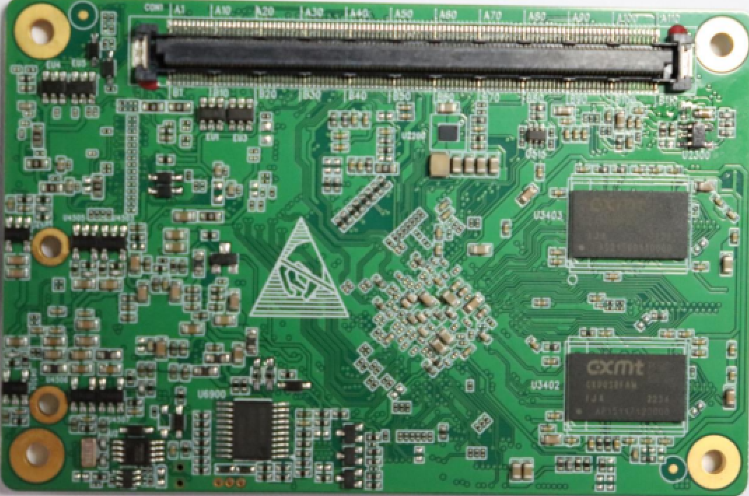
- Connector: Standard 220-pin COM-E Compact Type 6 connector. Standardized carrier boards can be compatible across manufacturers, provided the Type 6 pin map is strictly followed.
- Environment: Industrial wide-temperature operation and enhanced EMC performance, suitable for long-term 7 × 24-hour operation.
Key point: The RK3568 has limited SerDes resources. SATA, PCIe, and USB 3.0 share PHY resources. COM-E module manufacturers may offer different configurations with certain interfaces omitted or reallocated. When selecting a module, the pin multiplexing table must be checked carefully. An x86 COM-E carrier board design cannot be directly reused without verification.
Representative RK3568 COM-E Models
TOE-RE99 (Sakway / Zhongwei Information)
Compact Type 6 with dual Gigabit Ethernet, primarily targeting domestic industrial control HMI and gateway applications.
The product uses the general-purpose RK3568 SoC, integrating a quad-core ARM Cortex-A55 processor and a high-performance Mali-G52 2EE GPU. It supports 4K 60 fps H.265/H.264/VP9 video decoding and 1080p 60 fps H.265/H.264 video encoding, with a maximum CPU frequency of 2.0 GHz.
Detailed specifications are as follows:
| Item | Category | Description |
|---|---|---|
| Processor | CPU | Rockchip RK3568 quad-core processor, with a maximum clock speed of 2.0 GHz, integrating a Mali-G52 2EE GPU and supporting 4K decoding and 1080p encoding |
| Memory | Type | Onboard DDR4, 4 GB standard |
| Storage | FLASH | Reserved onboard SPI NOR FLASH, 64 MB |
| Storage | eMMC | Onboard industrial-grade 64 GB eMMC, supporting up to 128 GB |
| COM-E Interfaces | USB | 1 × USB 3.0_HOST (optional SATA 3.0); 2 × USB 2.0_HOST; 1 × USB 2.0_OTG (optional USB 3.0_HOST) |
| COM-E Interfaces | SATA | 2 × SATA 3.0 interfaces (USB 3.0_HOST multiplexed with SATA1; PCIe 2.1 multiplexed with SATA2) |
| COM-E Interfaces | PCIe | Default configuration: 2 × PCIe 3.0 × 1; optional 1 × PCIe 3.0 × 2; 1 × PCIe 2.1 × 1 (multiplexed with SATA2) |
| Network | Ethernet | 2 × Gigabit Ethernet ports (YT8531SH), one of which optionally supports RGMII (3.3 V) |
| Serial Ports | UART | 4 × TTL serial ports |
| Display | Display Outputs | Default: 1 × single-channel LVDS; optional single-channel MIPI, supporting a maximum resolution of 1920 × 1080; alternatively, optional eDP output (2560 × 1600). 1 × HDMI display interface, supporting 4K resolution (4096 × 2304) |
| I2C | I2C | 1 × I2C interface |
| SPI | SPI | 1 × SPI interface (optional 1 × CAN 2.0) |
| CAN | CAN | 2 × CAN 2.0 interfaces, expandable to a maximum of 3 × CAN 2.0 interfaces, supporting the CAN 2.0B protocol |
| Audio | Audio Interfaces | Standard MIC input, Headphone-out, and SPK audio interfaces. The SPK interface supports single-channel output of 1.3 W |
| GPIO | GPIO | 12 × GPIO, configurable as GPI or GPO |
| Dedicated Interfaces | MIPI Input Interface | Supports 1 × MIPI_CSI interface; board-to-board connector: TXGA FBB04004_F series |
| Debug Interfaces | Debug Ports | Debug UART, MCU serial port, CPU_ejtag |
| Power Supply | Type | Standard DC 5 V/12 V input, supporting a wide DC input range of 4.5–20 V |
| Power Supply | Power-On Mode | Supports AT mode with automatic startup when power is applied; optional ATX mode with button-triggered power-on |
| Power Supply | Standby Mode | Supported |
| Power Supply | Power Consumption | 2–6 W (2 W in idle mode; no more than 6 W under full memory stress testing) |
| Physical Parameters | Dimensions (W × D) | 84 mm × 55 mm (MINI COM-E module) |
| Environmental Adaptability | Commercial Grade | Operating temperature: 0°C to 50°C, 5–95% RH, non-condensing. Storage temperature: -20°C to 70°C, 5–95% RH, non-condensing |
| Environmental Adaptability | Industrial Grade (using wide-temperature components) | Operating temperature: -25°C to 60°C, 5–95% RH, non-condensing. Storage temperature: -40°C to 85°C, 5–95% RH, non-condensing |
Operating System and Software Ecosystem
- Linux: Version 5.10 is mainstream, with some versions offering 6.1; supports Buildroot and Debian.
- Android 11
- Domestic operating systems: UnionTech UOS and Kylin (a key adaptation focus for domestic COM-E versions).
- Drivers: Dual Ethernet, SATA, PCIe, MIPI, CAN, display, and NPU; manufacturers provide a BSP, device tree, and reference schematics for the carrier board.
Typical Application Scenarios
- Industrial HMI (Human-Machine Interface)
- Industrial edge gateways and data acquisition terminals
- NVR network video recorders and small NAS storage systems
- Medical industrial control and testing equipment
- Self-service terminals, digital signage players, and multi-display terminals
- Lightweight AI vision applications (code reading and defect detection)
Advantages and Disadvantages
✅ Advantages
- Standard COM-E form factor: The core module is separated from the carrier board. Upgrading the core module later does not require redesigning the baseboard.
- RK3568 interfaces are highly suited to industrial control: Dual Gigabit Ethernet, SATA, PCIe, multiple CAN interfaces, and multiple display outputs.
- Domestic supply chain options are available: Solutions such as TOE-RE99 can meet the requirements of Xinchuang (IT application innovation) projects.
- Low power consumption: Passive cooling is sufficient, without the need for a large fan.
- Mature ecosystem: Stable BSP support and numerous mass-production implementations.
⚠️ Limitations
- Shared SerDes resources: SATA, PCIe, and USB 3.0 cannot all operate at full capacity simultaneously. Trade-offs must be made during hardware design.
- ARM COM-E implementations are developed and adapted by domestic manufacturers: They are not an ARM standard natively defined by the COM organization. Pin definitions may vary slightly between manufacturers, so they are not fully plug-and-play in the same way as x86 COM-E modules.
- The NPU delivers only 1 TOPS of computing power: It is suitable only for lightweight AI applications and cannot run large models.
- Weaker GPU and multimedia performance compared with the RK3588: Not suitable for complex vision applications.
Key Items to Verify When Selecting a Module
- Chip model: RK3568J (wide-temperature version) or RK3568B2.
- PHY multiplexing scheme: How are SATA, PCIe, and USB 3.0 resources allocated?
- Ethernet PHY model: Is a domestically manufactured PHY used?
- Operating temperature range and EMC rating.
- BSP kernel version: Is the device tree source code provided?
- Connector pin definitions: Does the module strictly follow Type 6, and are there any custom multiplexing configurations?
- Memory bandwidth and ECC support.